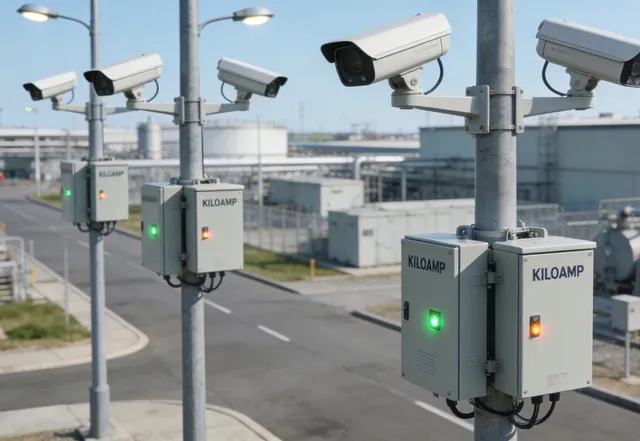


Power over Ethernet (PoE) is an innovative technology that enables simultaneous power transmission and data communication via standard Ethernet cables (Cat5/Cat6). A PoE system uses a Power Sourcing Equipment (PSE, e.g., PoE switches) to deliver up to 60W (per IEEE 802.3bt standards) of DC power to Powered Devices (PDs, e.g., IP cameras, wireless APs, IoT terminals), while supporting gigabit (1000BASE-T) data transfer. It is widely applied in wireless communications, surveillance, smart buildings, and industrial IoT. Its core advantage lies in simplifying cabling infrastructure and reducing deployment costs by 30–50%.
Compared to traditional power systems, PoE systems face distinct lightning protection challenges. PoE integrates power delivery into data channels, creating dual pathways for surge intrusion. PoE cables, which carry up to 60W of power and 1,000Mbps data, are vulnerable to lightning surges via two modes:
Power-line coupling (direct surge propagation through power pairs).
Electromagnetic induction (induced voltages in data lines).
This dual threat risks damaging both power and data components of PDs and PSEs.
A. Protection for PD Devices (Powered Devices)
Outdoor PDs (e.g., IP cameras, APs) are often installed in high-risk areas like rooftops or poles.
Solution: Use single-port surge protectors (e.g., KILOAMP KSP48-401):
Technical Specifications:
Voltage: 48VDC (backward-compatible with 24V/12V systems).
Performance: 10kA (8/20μs), <1ns response time.
Data Support: 100/1000Mbps.
B. Protection for PSE Devices (Power Sourcing Equipment)
Multi-port protectors (e.g., KILOAMP KSP48-408) are required for PSEs like PoE switches:
Key Features:
Port Density: Modular expansion to 8, 16, or 24 ports.
Compatibility: IEEE 802.3af/at/bt protocol support (hot-swappable).
Voltage: 48VDC (backward-compatible).
Data Support: 100/1000Mbps.
Surge Capacity: Imax ≥10kA.
KILOAMP PoE surge protectors are installed in series with PoE lines. Their three-tier protection technology safeguards both power pairs (4/5, 7/8) and data pairs (1/2+3/6). Within 100ns, they clamp surge voltages over 10,000V to within 120V, ensuring robust protection for PoE devices.
After deploying a KSP48-408 + KSP48-401 combination:
Lightning-induced damage rate: Reduced from 17% to 0.3%.
Mean Time Between Failures (MTBF): Increased to 50,000 hours.
Signal error rate: Maintained below 10⁻¹².
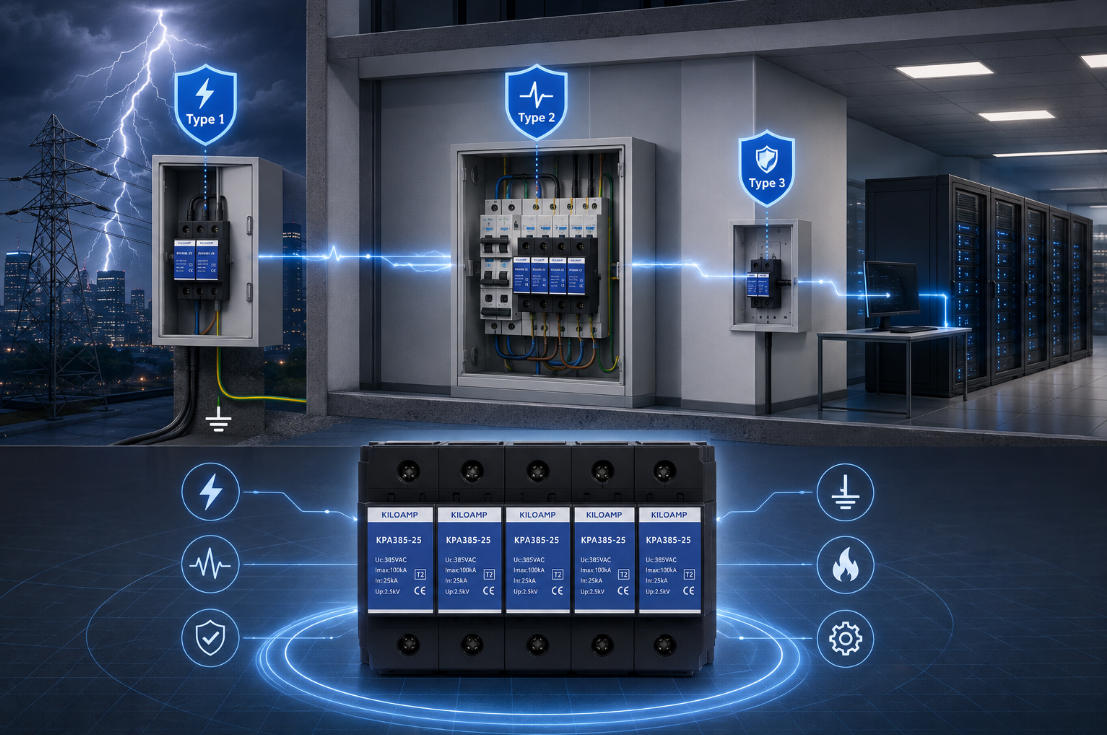
This three-tier protection architecture combined with rigorous engineering practices aligns with IEC 62305 standards, significantly enhancing the reliability of critical infrastructure.
Grounding:
Ensure ground resistance <4Ω.
Keep grounding wire length ≤0.5m.
Shielding:
Use shielded cables and conduit (e.g., galvanized steel pipes).
Ground conduits every 20 meters to create a "segmented discharge path."
Effective PoE lightning protection requires:
1. High-quality surge protectors (e.g., KILOAMP series).
2. Rigorous grounding and shielding measures.
3. Compliance with international standards (e.g., IEC 62305).
By integrating these strategies, PoE systems can achieve reliable, long-term operation even in lightning-prone environments.
Note: Product specifications and configurations should align with local regulatory requirements and system voltage/power demands. Regular maintenance and surge testing are recommended to ensure sustained performance.


 English