

Petrochemical tank farms are typically located in remote, open areas, with tanks storing toxic, hazardous, or flammable/explosive materials. The metallic structure of the tanks makes them vulnerable to lightning strikes. According to incomplete statistics, over the past 50 years, nearly 10% of tank fires globally were caused by lightning-induced surges. The primary risks include:
Direct lightning strikes: Igniting explosive gas mixtures inside tank seals.
Surge intrusion: Overvoltages from lightning damaging electrical equipment or control systems.
Therefore, lightning protection for tank farms must follow the "zoned protection, staged discharge, and equipotential bonding" strategy, combining direct lightning protection and surge suppression.
(1) Lightning Arrestor System
Coverage: Install lightning rods (arrestor rods) and lightning straps (arrestor bands) to protect all facilities within the tank farm.
Tank Wall Thickness: Ensure metallic tank walls are ≥4mm thick to conduct lightning currents effectively.
(2) Grounding System
Layout:
Structure: A ring-shaped grounding grid, buried ≥0.8m deep, with grid spacing ≤10m×10m.
Materials: Use copper-coated steel or galvanized flat steel (40×4mm). Grounding resistance ≤4Ω (≤1Ω in explosion hazard zones).
Bonding:
Resistance between pipe flanges ≤0.03Ω.
All exposed metallic parts (equipment enclosures, conduits, cable sheaths) must be grounded.
(3) Shielding and Isolation
Cable Shielding: Use shielded cables (STP/FTP) for critical signal and control lines, with both ends grounded.
Explosion Zone Isolation: Use explosion-proof SPDs (Ex d IIC T6 certified) in Zone 1 areas.
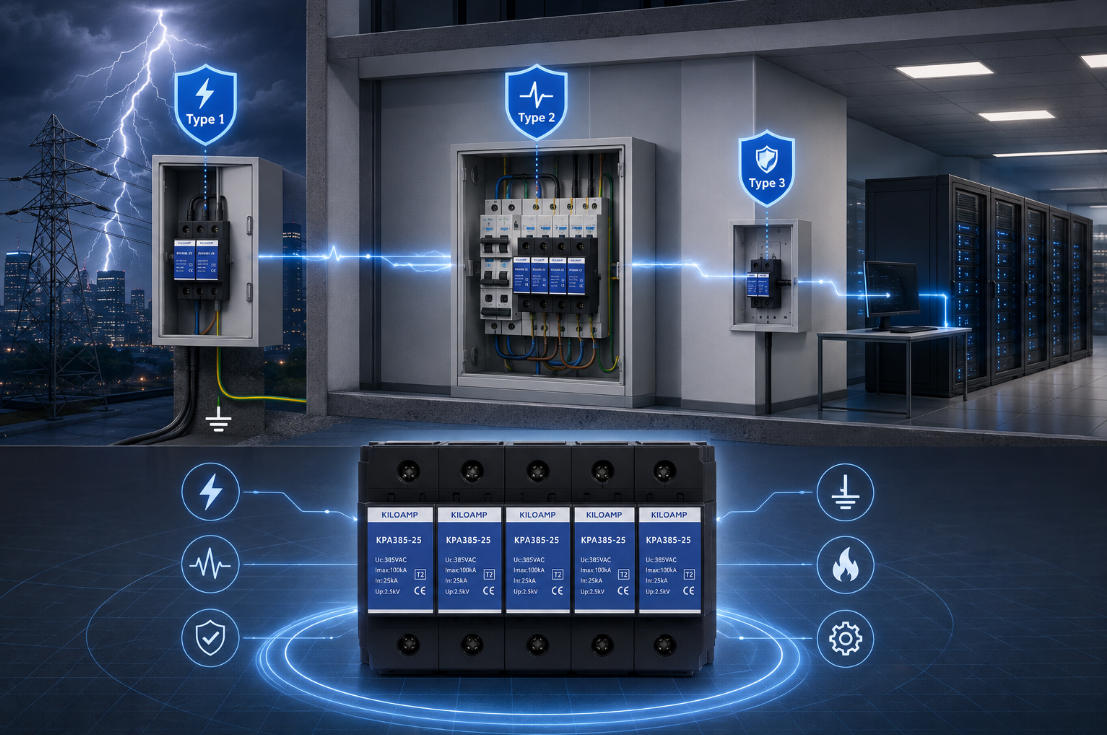
Core Principle: Three-tiered protection (IEC 61312 standard), progressively absorbing surge energy and reducing residual voltage.
1. Low-Voltage Power Distribution System
Protection Level | Installation Position | SPD Type | Key Parameters | Recommended Model |
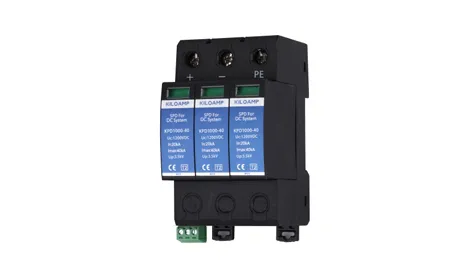
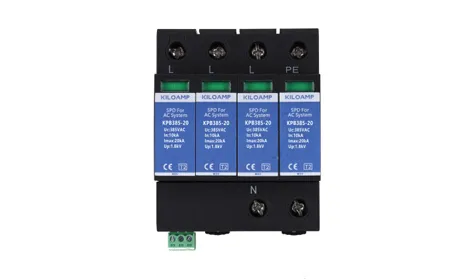
Primary | Transformer secondary side | Switching-type SPD | Nominal discharge current ≥25kA (10/350μs), Up ≤2.5 kV, response time ≤100ns | KILOAMP KPA385-2540R |
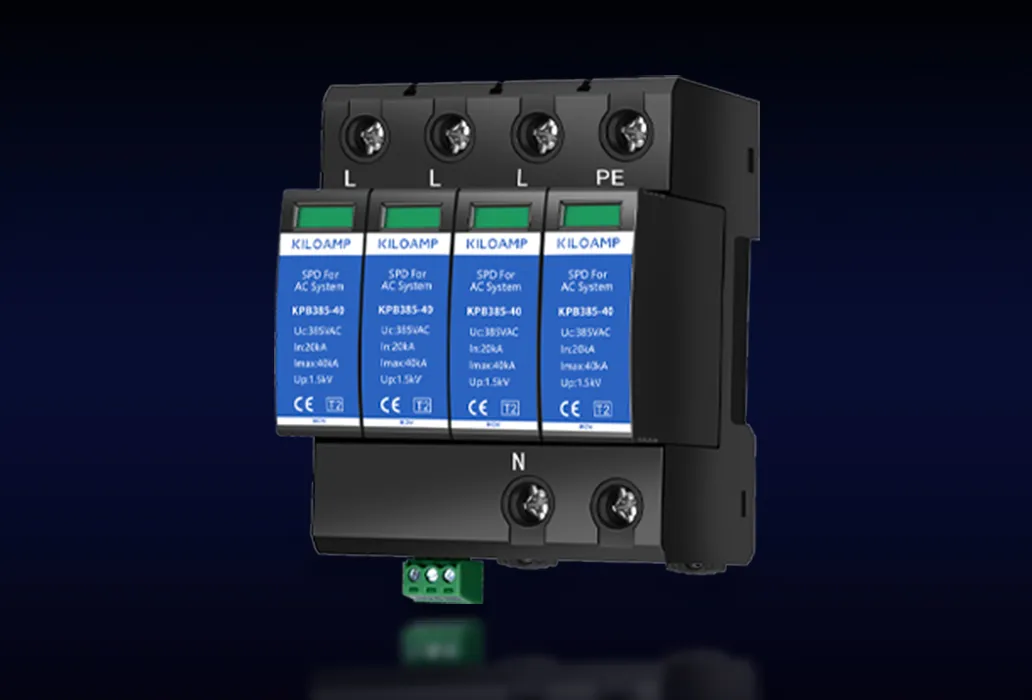
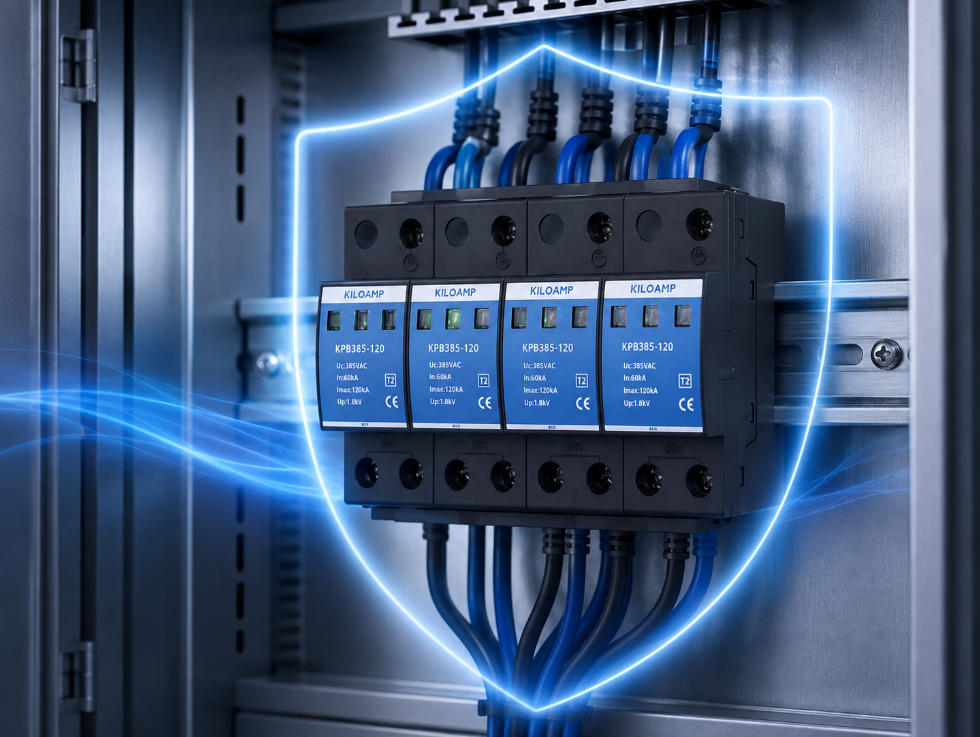
Secondary | MCC cabinet inlet | Voltage-limiting SPD | Nominal discharge current ≥100kA (8/20μs), Up ≤2.0 kV, response time ≤25ns | KILOAMP KPB385-10040R |
Tertiary | Critical equipment (DCS/PLC) | Precision SPD | Nominal discharge current ≥40kA (8/20μs), Up ≤1.5kV, response time ≤1ns | KILOAMP KPB385-4040R |
Explosion Zone | Zone 1 equipment | Explosion-proof SPD | Ex d IIC T6 certified, nominal discharge current ≥20kA, Up ≤1.2kV | KILOAMP KPB385-20EX |
Implementation Notes:
Spacing: Keep ≥10m between primary and secondary SPDs; otherwise, install a decoupler.
Safety: Series fuse (capacity matched to SPD) at the SPD front end.
Oil Pump Motors: Add isolation transformers (≥5kV withstand voltage).
Grounding: SPD grounding wire ≤0.5m long, cable cross-section ≥6mm².
2. Automation Control System (DCS/PLC)
Key Components and Solutions
Protection Object | Installation Position | SPD Type | Key Parameters | Recommended Model |
Control cabinet power | DIN rail mounting | Power SPD | Up ≤1.5kV, response time ≤25ns | KILOAMP KPB385-2040R |
AI/AO Signal Lines (4–20mA) | Signal inlet | Low-impedance SPD | Insertion loss <0.5dB, Up ≤30V, bandwidth 0–20MHz | KILOAMP KSC24-201 |
Fieldbus (Profibus/Modbus) | Bus interface | Bus SPD | Supports 12Mbps, Up ≤50V, RS-485 compatibility | KILOAMP KSC-PROFIBUS |
Fiber-optic Links | OLT power terminal | Fiber-optic SPD | 24VDC power protection, Up ≤50V, response time ≤1ns | KILOAMP KPO-24V |
Implementation Notes:
Signal SPD: Install as close to the equipment as possible.
Shielded Cables: Single-ended grounding (control room side) to avoid ground loops.
Fiber-optic Cables: Run through metallic conduits with both ends grounded.
3. Video Surveillance System
Key Components and Solutions
Protection Object | Installation Position | SPD Type | Key Parameters | Recommended Model |
Explosion-proof cameras | Camera pole distribution box | 3-in-1 SPD | Protects power (24V/220V), video (RJ45), and control signals (RS-485), Up ≤1kV | KILOAMP KVC-3IN1 |
Fiber-optic Links | OLT power terminal | Fiber-optic SPD | 24VDC power protection, Up ≤500V, response time ≤1ns | KILOAMP KPO-24V |
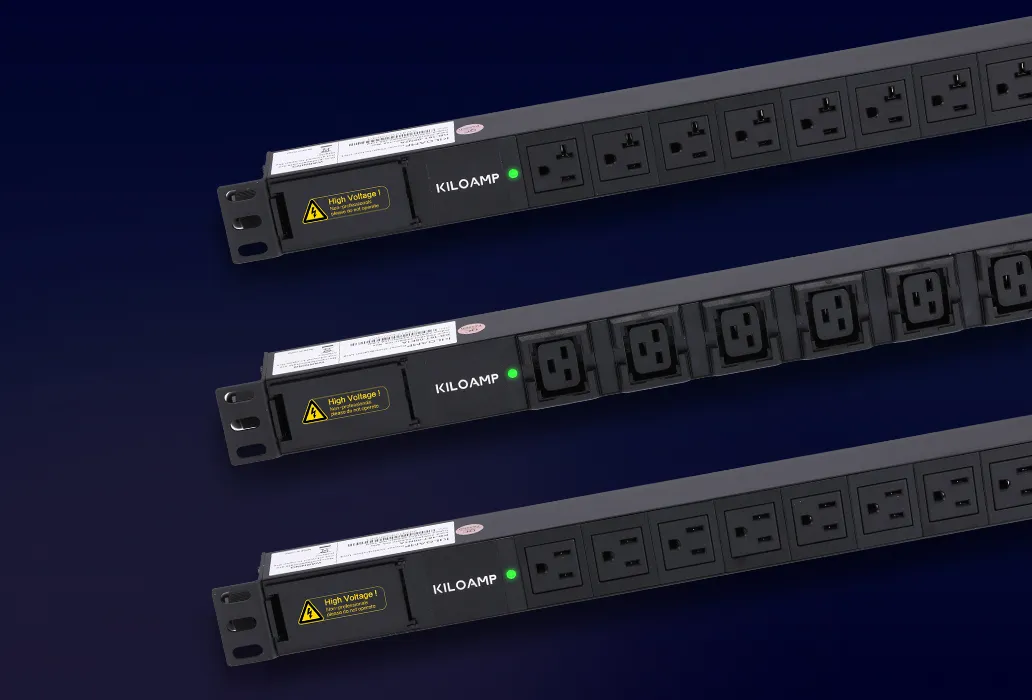
Monitoring Center Equipment | NVR/server cabinet | Rack-mounted SPD | Integrates network (RJ45) and power (220V) protection, supports 10Gbps transmission | KILOAMP KVR-1U |
Implementation Notes:
Camera Poles: Ground separately (resistance ≤4Ω).
PoE Switch Ports: Install network SPDs (e.g., KILOAMP KSE05-401, ≥5kA).
Video Cables: Run through galvanized steel conduits with both ends grounded.
Test Item | Standard Requirement | Testing Tools |
SPD Visual Inspection | No burn marks, leakage, or counter triggers | Visual inspection + infrared thermography |
Ground Resistance Test | ≤Design value (typically 4Ω, ≤1Ω in explosion zones) | Ground resistance tester (e.g., Fluke 1625) |
Bonding Resistance Test | ≤0.03Ω (between flanges) | Micro-ohmmeter (e.g., Kyoritsu 4105AH) |
Insulation Resistance Test | ≥10MΩ (after disconnecting SPD) | 2500V megohmmeter (e.g., Megger MIT330) |
1. Zoned Protection:
Explosion Zone (Zone 1): Use explosion-proof SPDs (Ex-certified).
Control Zones: Three-tiered SPD protection with residual voltage ≤1.5kV.
2. Technical Specifications:
Response Time: Core SPDs ≤1ns to suppress nanosecond surges.
Compatibility: Supports DCS/PLC high-speed signals (12Mbps) and fiber optics (10Gbps).
3. Maintenance Strategy:
Conduct quarterly grounding system inspections.
Perform comprehensive SPD checks before the rainy season annually.
Use IoT-based monitoring systems for predictive maintenance to reduce lightning accident rates to below 0.01%.
The solution ensures compliance with international standards (IEC 61312, GB 50057) and domestic regulations (GB 3836). By integrating tiered SPDs, explosion-proof design, and intelligent monitoring, the system minimizes lightning risks and ensures operational safety in petrochemical tank farms.
Note: Customize the design based on site-specific conditions (e.g., soil resistivity, lightning frequency). Consult professional lightning protection engineers for on-site assessments.


 English